

How To Get To Shinjuku Gyoen National Garden
| Shinjuku Gyo-en | |
|---|---|
| Shinjuku Gyo-en National Garden | |
| 新宿御苑 | |
 | |
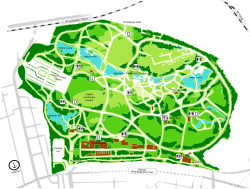 Map of the Shinjuku Gyo-en | |
| Type | National Park |
| Location | Shinjuku and Shibuya, Tokyo, Japan |
| Coordinates | 35°41′06″N 139°42′36″East / 35.685°N 139.710°East / 35.685; 139.710 Coordinates: 35°41′06″N 139°42′36″E / 35.685°N 139.710°E / 35.685; 139.710 |
| Expanse | 58.3 ha (144 acres) |
| Operated past | Japanese Ministry building of the Environs |
| Open | May 1906 (1906-05) |
| Condition | Open up |
| Plants |
|
| Website | www.env.become.jp/garden/shinjukugyoen |


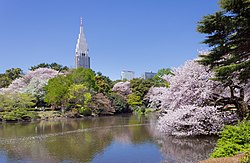
Cherry blossom of Shinjuku Gyo-en

Chrysanthemum flower exhibition

Wooden footbridge in Shinjuku Gyoen National Garden, a sunny day with blue heaven

Shinjuku Gyo-en National Garden view during fall flavour in Shinjuku, Japan.
Shinjuku Gyo-en ( 新宿御苑 ) is a large park and garden in Shinjuku and Shibuya, Tokyo, Japan. It was originally a residence of the Naitō family in the Edo flow. Later, it became a garden under the management of the Purple Household Agency of Nippon. It is at present a national park under the jurisdiction of the Ministry of the Surround.
History [edit]
The shōgun bequeathed this land to Lord Naitō (daimyō) of Tsuruga in the Edo flow who completed a garden here in 1772.[1] After the Meiji Restoration the house and its grounds were converted into an experimental agricultural centre.[2] It then became a botanical garden before becoming an majestic garden in 1879. The current configuration of the garden was completed in 1906. Most of the garden was destroyed past air raids in 1945, during the subsequently stages of World War II. The garden was rebuilt after the war.[ citation needed ]
The jurisdiction over the Imperial Palace Outer Garden and the Kyoto majestic garden was transferred to the Ministry of Health and Welfare (at present the Ministry of Wellness, Labour and Welfare) in 1947.[ commendation needed ]
On May 21, 1949, the garden became open to the public equally a national park. It came under the jurisdiction of the Ministry of the Environment in January 2001, with the official English proper noun "Shinjuku Gyoen National Garden". The official Japanese proper name remains Shinjuku Gyoen, where gyoen means "imperial garden".[3]
In 1989, the Shinjuku Gyoen was the site chosen for the funeral rites of Emperor Shōwa before he was cached at the Musashi Majestic Graveyard.[ citation needed ]
Features [edit]
The garden, which is 58.three hectares in surface area with a circumference of iii.v km, blends 3 distinct styles: a French Formal and English language Mural in the north and to the south a Japanese traditional. A traditional Japanese tea firm can exist found within the gardens. The garden is a favourite hanami (scarlet-blossom viewing) spot, and big crowds can be nowadays during cherry bloom flavor.
Flora [edit]
The garden has more than 20,000 trees, including approximately 1,500 cherry trees which bloom from late March (Shidare or Weeping Carmine), to early on April (Somei or Tokyo Cherry), and on to late April (Kanzan Scarlet). Other trees constitute here include the majestic Himalayan cedars, which soar in a higher place the balance of the trees in the park, tulip trees, cypresses, and plane trees, which were first planted in Japan in the Imperial Gardens.
Horticulture work has been going on in the greenhouses in the garden since 1892. The present greenhouse, built in the 1950s has a stock of over 1,700 tropical and subtropical plant species on permanent display.
Entrances and admission [edit]
The garden has iii access gates: Shinjuku Gate, Okido Gate and Sendagaya Gate. Shinjuku Gyoen is open from 9:00 until 16:30. On Mondays the garden is airtight, except during the cerise blossom and chrysanthemum seasons: late March–belatedly April and early November respectively, when the garden is open up 7 days a week. The greenhouse is open up from nine:30 until 16:00. The last admission is sixteen:00.
Location [edit]
The garden is a short walk from Shinjuku-gyoemmae Station on the Marunouchi Line or Sendagaya Station on the Chūō-Sōbu Line. The garden is on the Tokyo Metro Fukutoshin Line most Shinjuku-sanchōme Station. From that station (exit C1) the garden is a four-minute walk.
In popular civilization [edit]
In Yasunari Kawabata'southward The Sound of the Mount, Shingo declares, "You can stretch out. It's similar getting out of Japan - I wouldn't accept dreamed that there was a place like this right in the middle of Tokyo."[4]
It is the setting of the 2013 anime pic The Garden of Words.[5]
References [edit]
- ^ Mansfield. Folio 15.
- ^ Mansfield. Folio 15.
- ^ "Facilities and historical background". Ministry of the Environment.
- ^ Kawabata, Yasunari (1970). The Audio of the Mountain. New York: Vintage International. pp. 187–193. ISBN9780679762645.
- ^ Johnny (xiv March 2016). "Tokyo as Seen Through the Animated Film The Garden of Words". Spoon & Tamago . Retrieved 1 Feb 2017.
Bibliography [edit]
- Mansfield, Stephen (2011). Japan's Master Gardens - Lessons in Space and Surroundings (Hardback). Tokyo, Rutland, Singapore: Tuttle. ISBN978-4-8053-1128-viii.
External links [edit]
- Shinjuku Gyoen official website (English)

How To Get To Shinjuku Gyoen National Garden,
Source: https://en.wikipedia.org/wiki/Shinjuku_Gyo-en
Posted by: branamwithful.blogspot.com
0 Response to "How To Get To Shinjuku Gyoen National Garden"
Post a Comment